Article • 2 min read
Becoming a "Service Architect": The evolution of the human agent
AI isn't a replacement plan, it’s the toolkit agents need to evolve from reactive service reps into strategic Service Architects.


Jason Maynard
Chief Technology Officer (AMER) at Zendesk
最後更新: February 10, 2026


A narrative that has long hung over the heads of contact center leaders is that of AI slowly replacing agents and humans becoming increasingly less relevant. But if you speak to actual contact center leaders, you’ll hear a very different story.
We are facing a retention crisis, not a replacement crisis. The retention rates in contact centers have always been painfully low, averaged across industries at around 60%, equating to a team turn over every 4.5 years. The culprit isn’t a lack of work; it’s the kind of work. Agents are burning out on the hamster wheel of reactive support, resetting passwords, checking order statuses, and tagging tickets, leaving them with little capacity left for the complex problems that actually require empathy.
While AI will fundamentally change how we staff contact centers, it isn’t going to reduce the value of the human; in a world of Agentic AI the human voice is the ultimate connection. By offloading the Tier 1 requests, the repetitive, administrative burdens, we are clearing the way for a profound evolution in the agent’s role. We are moving away from the customer service representative as a reactive function and towards the more strategic “Service Architect.”
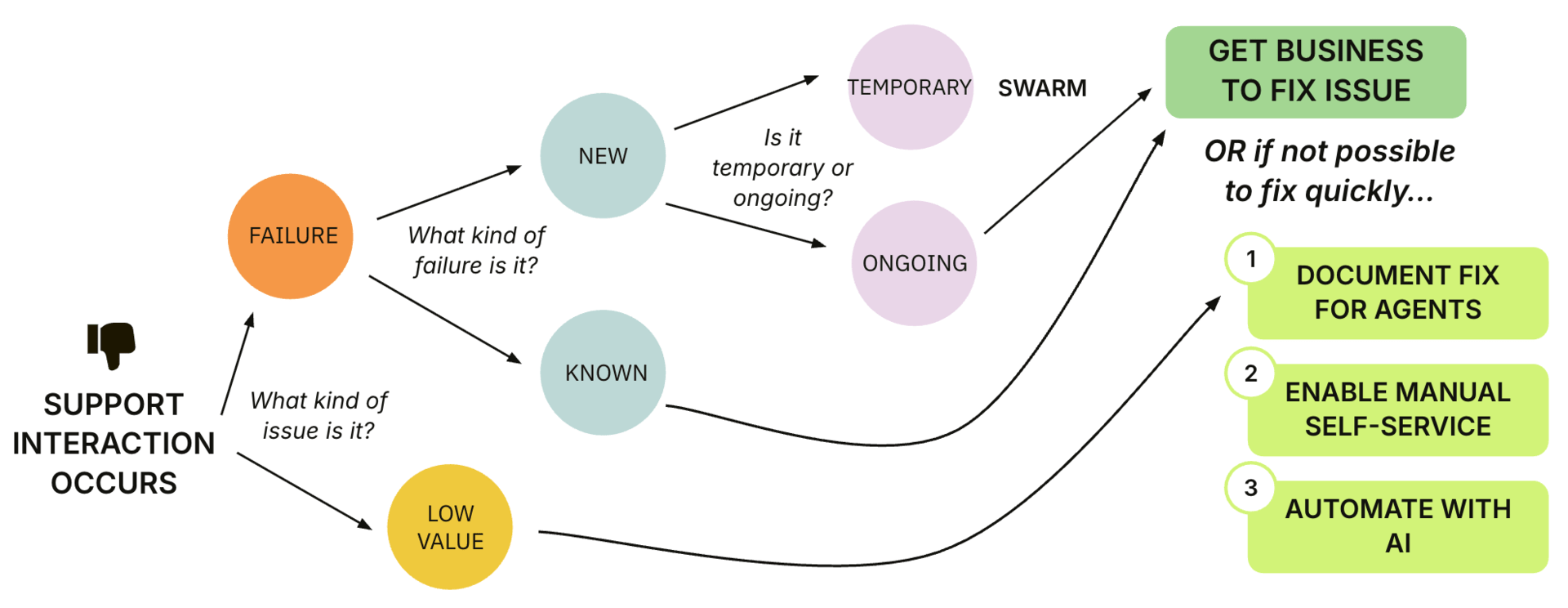
Beyond the catch-all: The hidden cost of reactive support
Currently, customer support often functions as the safety net solution for the shortcomings of every other customer-facing function, marketing, sales, and product. CX becomes the cleanup crew for other department’s mistakes. To understand how to fix this, we need to analyze the Service Interaction Spectrum. At Zendesk we manage billions of interactions each year and analyzing their intent, sentiment and language, we were able to categorize support volume into three distinct buckets.
- Failure interactions (47% of volume)
Nearly half of all support interactions are failures, instances where something has broken or gone wrong. These volume drivers include refunds, returns, product failures, and delivery delays. The reality is that these are not truly support problems; they are business problems that have rolled down to the support queue to be fixed.
- Low-value interactions (28% of volume)
These are routine, repetitive, or informational requests that don’t require human empathy or complex problem-solving such as checking an order status, updating an email address, or asking basic product usage questions. While necessary, these interactions often contribute to agent burnout and high operational costs without adding the deep strategic value that comes from human connection.
- High-value interactions (25% of volume)
Only a quarter of interactions today are true opportunities for relationship building, revenue growth, or complex consultative support where human empathy and expertise make a tangible impact. Unfortunately, this is often where agents are able to spend the least amount of their time.
Automate the mundane, elevate the human
To set CX up for success in the AI era, we must flip these ratios. The goal is to eliminate or automate failure and low-value interactions so that human talent can focus entirely on high-value opportunities:
- Fix and automate failures: For failure interactions, the ideal solution is to go upstream and get the business to fix the root cause. If that isn’t immediately possible, the strategy must be to document the fix and automate the resolution using AI.
- Delegate low-value tasks to AI: Low-value interactions are the ideal candidate for AI automation, provided there is always an escape valve for human escalation. The process starts by clearly documenting solutions in your knowledge base and enabling self-service via generative search to surface answers instantly. Businesses can then employ AI agents powered by adaptive reasoning to fully automate simple resolutions.
Once the burden of repetitive work is removed, we can focus humans on the high-value interactions. This brings us to the evolution of the human agent.
Enter the service architect
The concept of the “Service Architect” reframes the agent not as a processor of tickets, but as a driver of resolution.
A Service Architect doesn’t just answer questions, they look at the customer’s problem holistically, using the tools at their disposal to build a relationship and engineer a solution that prevents the customer from needing to contact the business again.
But agents can’t be expected to deliver a superior customer experience without the right tools. This is where AI can revolutionize day-to-day operations.
- The AI co-pilot: Driving agent productivity
Instead of searching for answers, AI Copilots ensure the answer comes to the agent. When a customer asks about a refund policy, the Co-pilot instantly surfaces the correct article from the knowledge base and drafts a response based on the context of the conversation.
With the information instantly available, the agent can now focus on the delivery. They can look at the Co-pilot’s suggestion, realize the customer is frustrated, and soften the tone or add a personalized reassurance that AI might miss.
The Copilot doesn’t just surface information, it can also suggest an appropriate response to a difficult objection, flag a relevant upsell offer all the while transcribing the call as it happens, analyzing the text for keywords, and intent.
- Real-time sentiment analysis: Emotional intelligence at scale
Human empathy is often cited as the one thing AI cannot replace. This is true, but AI can enhance it.
In the heat of a difficult call, even the best agents can miss subtle cues. Real-time sentiment analysis acts as an emotional compass. It can flag when a customer’s stress levels are rising before they even raise their voice. For an agent, this data is vital. It allows them to pivot their strategy mid-conversation. If AI flags negative sentiment, the agent knows to pause the troubleshooting process and focus on validation and repairing trust.
- Automated after-call work: Closing the loop
Perhaps the biggest killer of agent morale is After-Call Work (ACW). The interaction ends, but the work doesn’t. The agent spends two or three minutes typing summaries, selecting disposition codes, and updating the CRM. It is tedious, low-value work that prevents them from helping the next customer.
AI can automate this entirely. It listens to the call, generates a concise, accurate summary, tags the disposition, and updates the record, instantly. For the agent turned Service Architect, this is liberating. It means they can move from one problem to the next, rather than carrying the administrative baggage of the previous call.
So what does this mean for businesses?
As an overall trend, you would think this would result in less service jobs, but interestingly, customer service roles in the US are on the rise. Many factors are likely at play here but one explanation of this may be linked to a concept known as Jevon’s Paradox; as resources become increasingly efficient, this often leads to higher total consumption rather than less usage. As we make our contact center agents more efficient with AI, we’re incentivized to leverage them more as a differentiator.
By capitalizing on this efficiency to elevate the human role, businesses can unlock three distinct competitive advantages:
- You can attract and retain better talent: People want to do meaningful work. When you remove the drudgery, you make the role attractive to critical thinkers and problem solvers. You slow the churn of agents and reduce the costs involved with continual hiring and training.
- You boost First Call Resolution and Customer Satisfaction: When agents aren’t bogged down by tier-one queries (which AI agents can handle) and administrative tasks, they have the mental bandwidth to tackle complex, systemic issues. The Service Architect can spot patterns, like “Why are five customers calling about this specific error message today?” and flag them to product teams, effectively preventing thousands of future tickets.
- You increase customer loyalty: Where customers need quick answers, like order delivery updates or changing customer information, AI agents can seamlessly provide what they need. For more difficult concerns, when agents become Service Architects they can more easily provide that high-touch, personalized experience customers have come to expect, boosting their loyalty to a brand.
In fact, we have seen this success play out with Zendesk customer The Coffee Club. By implementing advanced routing and real-time analytics with Zendesk Contact Center, they were able to supercharge agent productivity, seeing their Average Handle Time (AHT) drop by 40%, while their Customer Satisfaction (CSAT) scores rose by over 12%.
The path forward
The reality of the AI revolution is that it will ultimately make customer service more human, not less.
By embracing AI, we aren’t removing manual tasks; we are shedding the busywork that forces your agents to only survive the queue. We are empowering them to step into their new role as problem solvers. The Service Architect is the future, but they cannot build on a broken foundation. This transition requires a single, unified platform that seamlessly integrates agent Co-pilot, real-time sentiment analysis and AI agents directly into the workflow in a single, intuitive workspace.
Zendesk Contact Center is that platform.
It’s how you move beyond operational efficiency to deliver better customer outcomes and a truly empowered agent workforce. Don’t just manage the ticket queue; equip your team to architect the kind of customer experiences that build true brand loyalty.


