Article • 8 min read
AI customer service agents: A guide to the future of intelligent support
AI agents can understand and resolve even the most sophisticated customer issues. Learn how they can boost customer satisfaction, improve service efficiency, and drive revenue.


Candace Marshall
Vice President, Product Marketing, AI and Automation
最後更新: January 19, 2026


Autonomous service agents powered by AI are the future of intelligent support. According to Zendesk’s 2026 CX Trends Report, nearly 90% of CX trendsetters believe 80% of customer issues will be resolved without human intervention in the next few years. In fact, AI customer service agents are already at the center of customer service, as they can understand and resolve simple or complex issues across channels like voice, email, and messaging.
Unlike traditional chatbots, customer service AI agents deliver truly conversational, human-like interactions, analyzing customers’ questions and sentiment in real time and personalizing support accordingly. They can even automate workflows and retrieve customer-specific information. Although they excel in autonomously resolving complex issues, they also work with human agents seamlessly, benefiting customers, agents, and admins alike.
In this guide, we’ll explore what AI customer service agents are, the benefits of using them, and why they’re becoming indispensable to modern CX strategies. Let’s explore what the future of customer service looks like.
More in this guide:
- What is an AI agent in customer service?
- How do AI agents work in customer service?
- Benefits of AI customer service agents
- AI customer support agents use cases across industries
- The future of artificial intelligence agents
- Frequently asked questions
- Choose the most autonomous AI agents in the industry
What is an AI agent in customer service?AI agents are AI-powered bots designed to understand and autonomously resolve even the most sophisticated issues on any channel. Using agentic AI, the agents can reason, adapt, and act independently, detecting a customer’s intent and sentiment to provide the right resolution. AI agents go beyond the capabilities of traditional bots, interacting with customers in dynamic, human-like conversations and guiding them all the way to a solution, with or without human assistance. |
How do AI agents work in customer service?
Here’s a simple way to understand how AI agents work in customer service: when a customer asks a question, AI agents automatically recognize the intent. Based on the topic, the AI agent either looks for the information in the company’s knowledge base, or for topics that require more personalization, it guides them through a conversation flow.
Digging deeper into how AI agents work, it’s important to know the technologies and processes involved. AI customer support agents are built on AI models trained on CX data using machine learning (ML) algorithms, natural language processing (NLP), large language models (LLMs), and various other AI technologies to continuously refine and enhance their responses.
These capabilities allow them to automate complex service processes such as routing, classification, and resolution through AI-powered ticketing automation, ensuring faster response times and smoother workflows across every channel.
However, it’s worth noting that not all AI systems are created equal. To strengthen human connection, AI agents for customer service need to be specifically designed for that purpose. These agents are experts in customer service from the outset, providing accurate, personalized support without any coding or engineering help required.
Benefits of AI customer service agents
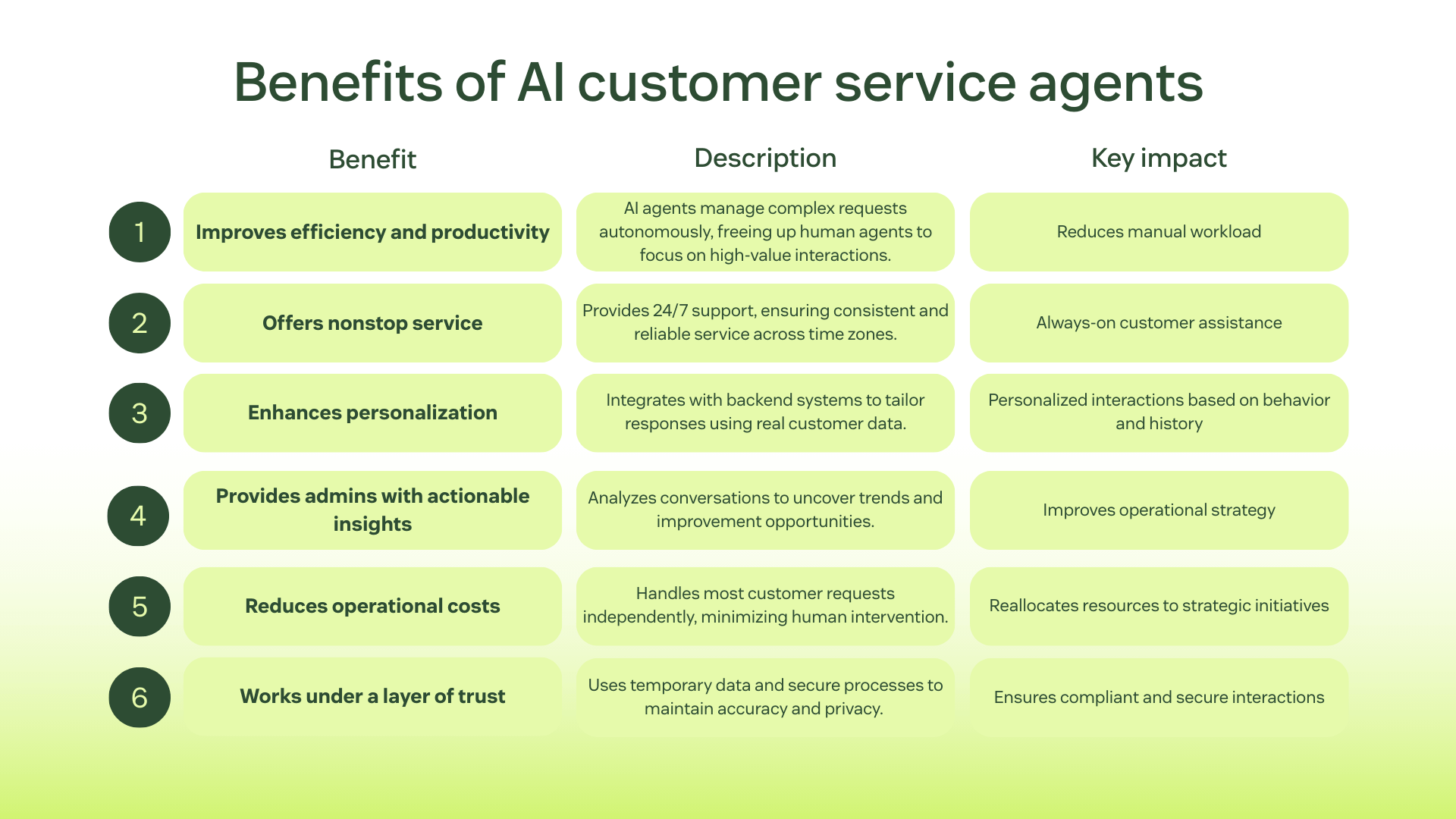
Businesses are increasingly leveraging autonomous AI agents to transform both the customer experience (CX) and employee experience (EX). Using AI agents benefits an entire organization: customers, human agents, and support admins. Here’s how.
Improves efficiency and productivity: AI agents can handle complex requests without a human agent ever needing to get involved, giving your support teams valuable time back to focus on more meaningful work. These intelligent agents can also gather information, organize ticket backlogs, automatically send CSAT surveys after interactions, verify users, and much more, significantly reducing human agents’ manual work.
- Offers nonstop service: AI agents can provide 24/7 support, ensuring customers are always assisted, regardless of the time zone. This improves customer success and loyalty, allowing businesses to handle increased support volumes during growth periods and busy seasons in a cost-effective way.
Enhances personalization: AI customer service agents integrate with backend systems and use customer data, such as purchase history, preferences, and behaviors, to personalize responses. They can also send human agents key details about the customer, like their intent and sentiment, to help the agent tailor their responses to specific customer needs.
Provides admins with actionable insights: AI agents can analyze customer conversations to identify trends and areas for businesses to improve support operations. They’re capable of suggesting the questions they handle best, helping admins know what to automate next.
Reduces operational costs: By resolving a majority of customer requests on their own, AI agents can significantly reduce the workload on human agents. This translates to lower operational costs for businesses, allowing them to invest resources in other areas.
Works under a layer of trust: With the right controls in place and temporary use of data, AI agents are optimized to answer customers in the most accurate and protected way possible.
AI customer support agents resolve issues independently and assist human agents, streamlining the path to resolution and ultimately providing a more elevated customer experience.
AI customer support agents use cases across industries
AI agents are versatile, so they aren’t limited to one type of business. From automating repetitive tasks to providing personalized, real-time assistance, AI agents adapt to the unique needs of each sector.
Here are a few key ways different industries are putting AI agents to work.
Industry | How AI agents are used |
Customer service | AI customer service agents answer FAQs, troubleshoot issues, and even process refunds, giving human agents time back to build stronger customer relationships. |
Information Technology (IT) | AI agents troubleshoot technical issues like password resets and VPN access and automate repetitive tasks. |
Human Resources (HR) | AI agents answer employee questions about benefits or company policies, automate onboarding processes, and pre-screen job applications. |
Sales and marketing | AI agents use real-time data to recommend new products or upgrades based on customer behavior and history. |
Healthcare | AI agents assist with appointment scheduling, answer basic health questions, or connect to the appropriate department based on the health concern. |
Finance | AI can automate fraud detection, personalize investment recommendations, and streamline loan applications. |
Retail and e-commerce | AI agents track orders and provide personalized status updates, prompt return label creations, answer product questions, recommend items based on purchase history, and personalize the shopping experience. |
Travel and hospitality | AI agents can help book flights and hotels, answer travel-related questions, and suggest personalized itineraries. |
Telecommunications | AI agents can deflect network outage questions by providing personalized, immediate support. |
Entertainment and media | AI agents help subscribers find shows, movies, or music within a service, answer content-related questions, and personalize recommendations. |
The future of AI agents in customer service
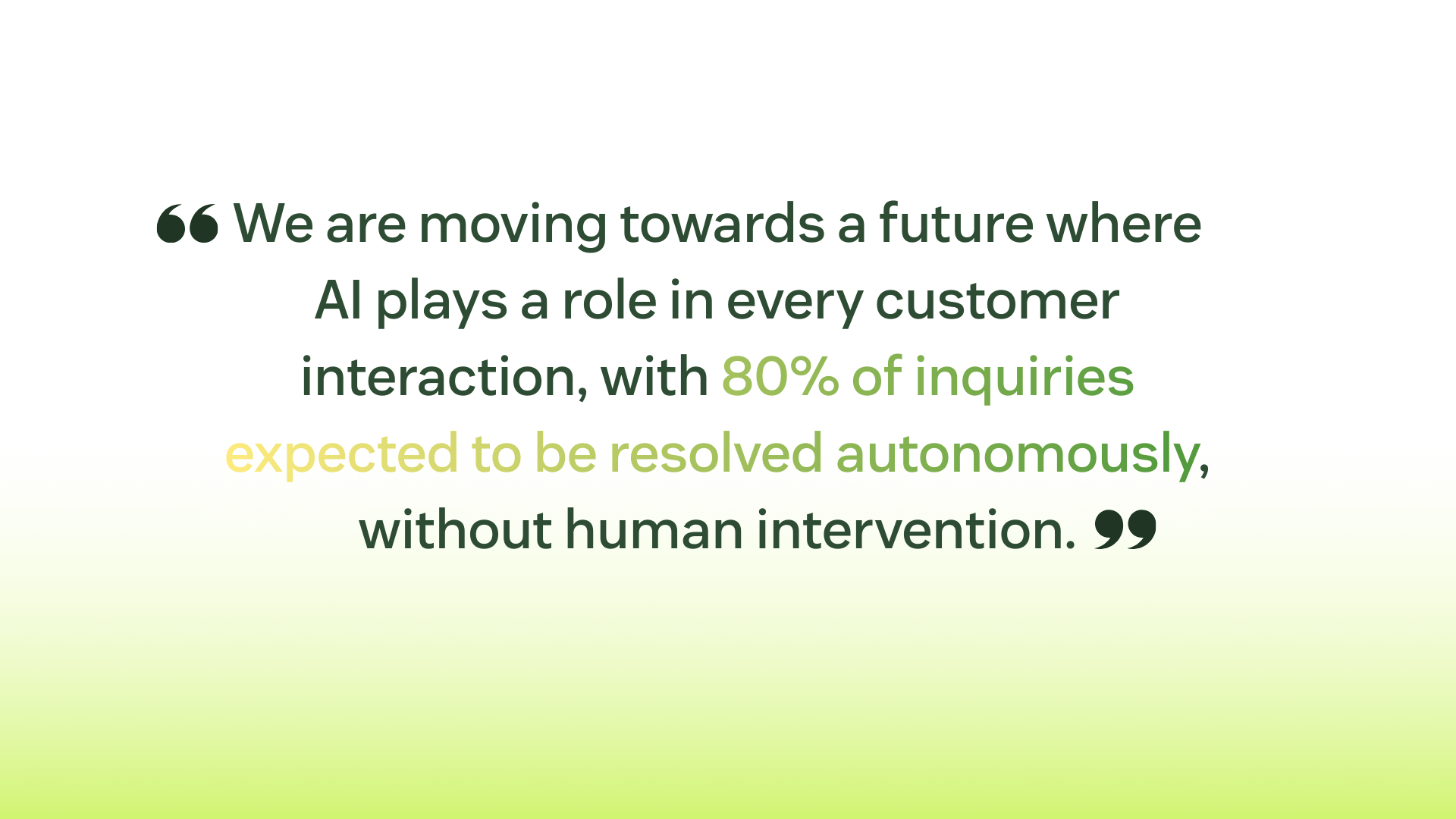
As technology continues to advance, AI is reshaping how we work. We are moving towards a future where AI plays a role in every customer interaction, with 80% of inquiries expected to be resolved autonomously—without human intervention.
AI agents are rapidly evolving and becoming more accessible, so you no longer need to sacrifice customer connection for efficiency or compromise quality for cost. The right AI-powered CX solution can deliver on all these aspects simultaneously.
AI agents are becoming adept at crafting highly personalized customer journeys, growing more sophisticated by the day. 75% of consumers who have experienced generative AI technology believe it will change how they interact with companies, according to our CX Trends Report. As AI continues to learn and develop, it opens up endless possibilities for elevating the customer experience.
During this era of AI-enhanced customer experiences, it’s crucial to stay focused on what’s truly important: the human on the other side of the interaction. Selecting AI solutions that genuinely understand your customers is key.
By recognizing the humanizing power of AI, you can create proactive, efficient, empathetic, and authentically human experiences that benefit your customers, agents, admins, and every person AI agents interact with. Still, it’s worth mentioning that AI customer services won’t replace human agents entirely, but together they’ll create a more efficient and personalized customer experience.
Frequently asked questions
Choose the most autonomous AI customer service agents in the industry
Zendesk AI agents are the most autonomous AI-powered bots in the industry. They can take care of a customer’s entire request from start to finish, handling up to 80 percent of your interactions. Unlike other solutions, our AI agents are experts in customer service and purpose-built to enhance human connection, which means they are designed to understand complex questions and deliver fast, accurate, and personalized support.
With AI that knows exactly what your customers need before they do, gets smarter and better over time, and doesn’t require technical expertise, Zendesk is helping businesses deliver AI-powered customer experiences that are more authentically human.


