Article
9 customer data management best practices for CDM success
Customer data management is the practice of ethically collecting, securely storing, and seamlessly managing customer information. Read on for nine tips for CDM success.


Kevin Boyer
Sr. Director, Product Marketing
最後更新: February 12, 2026


What is customer data management?Customer data management (CDM) is the practice of ethically collecting, securely storing, and managing a database of customer information to improve a company’s overall services, processes, and products. CDM ensures businesses can leverage data for personalized customer service and business intelligence while adhering to data protection regulations. |
Faster response times and deeper discounts may be enticing, but they don’t compensate for a weak data foundation. Effective customer data management (CDM) is the cornerstone of brand trust—it ensures your customer information remains secure, accurate, and actionable.
Proper data collection and management are absolutely essential for ensuring that your company avoids data breach issues and the resulting loss of customer trust. Beyond that, well-managed data can optimize customer support, deliver more personalized interactions, and even boost sales by better understanding your audience’s needs.
In this article, we’ll dig into what customer data management entails and break down nine strategies you can implement right away to protect your data, build trust, and create a seamless customer experience (CX).
More in this guide:
- What are the benefits of customer data management?
- What is the customer data management process?
- 9 Customer data management best practices
- Frequently asked questions
- Streamline customer data management with Zendesk
What are the benefits of customer data management?
Many benefits come from effective customer data management, including:
- Increased customer acquisition: With effective data collection and analysis, businesses can identify their ideal target customers and tailor marketing campaigns accordingly. This helps save resources and efforts on unqualified leads.
- More upsell and cross-sell opportunities: When businesses have a clear understanding of customer behavior and preferences, they can act proactively to recommend relevant products and services. This anticipation of customers’ needs helps them see the brand as attentive and thoughtful.
- Enhanced customer trust: Adhering to data governance and compliance regulations demonstrates respect for privacy and security, building customer confidence and trust.
- Improved customer retention, customer lifetime value, and customer loyalty: Customer data management allows businesses to engage with customers according to what they need, when they need it. This timely and personalized engagement strengthens relationships, which contributes to increased repeat purchases and decreased churn rates.
- Higher customer satisfaction: Information that comes from customer interactions can be turned into valuable insights. These insights help agents resolve issues faster and meet customers’ expectations, increasing customer satisfaction.
- Increased competitive advantage through a more personalized customer experience: Personalization improves customer engagement and makes brands stand out by delivering a unique and memorable experience. Companies can use customer data management to craft meaningful, customer-centric interactions.
- Stronger customer relationships: With data-driven insights, you can have a deeper understanding of each customer’s journey and preference. This understanding helps foster stronger relationships through connections that feel human and empathetic.
- Unified customer view: Integrating data from multiple sources creates a single, comprehensive profile for each customer. This unified view enables all departments to work with consistent, accurate information, which turns into more cohesive customer engagement.
Effective CDM allows businesses to truly understand their customers and use that knowledge to drive better business outcomes.
What is the customer data management process?
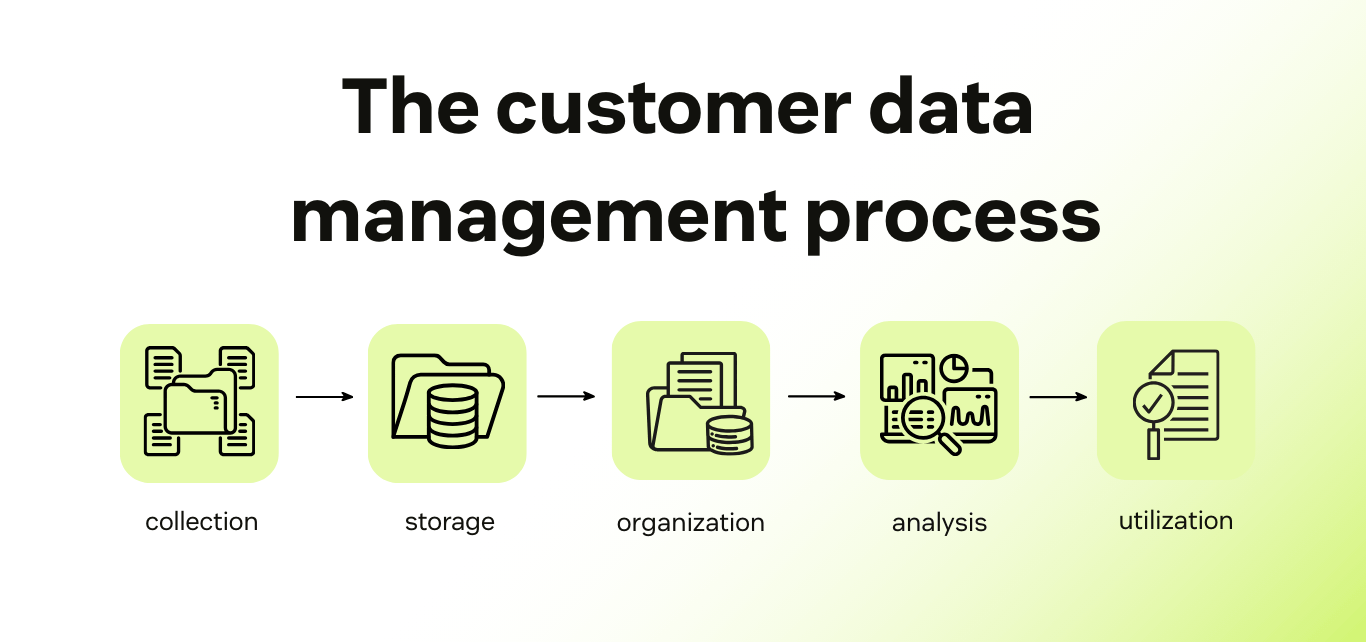
The customer data management process typically involves:
- Collecting customer data from various sources and touchpoints, such as web forms, customer service software, point-of-sale systems, and transactions.
- Securely storing data in a centralized location, often within databases or data warehouses.
- Cleansing data and integrating it across various systems and touchpoints.
- Segmenting data based on specific criteria, such as demographics, behavior, or engagement level.
- Extracting insights through data analysis to inform decision-making.
- Using data to personalize customer interactions, optimize product offerings, or drive business strategies.
- Implementing data security and compliance through policies and procedures.
- Regularly updating and validating data to ensure its ongoing accuracy and relevance.

2026 customer data privacy guide
Learn how your business can help keep consumer data private with our guide.
9 Customer data management best practices
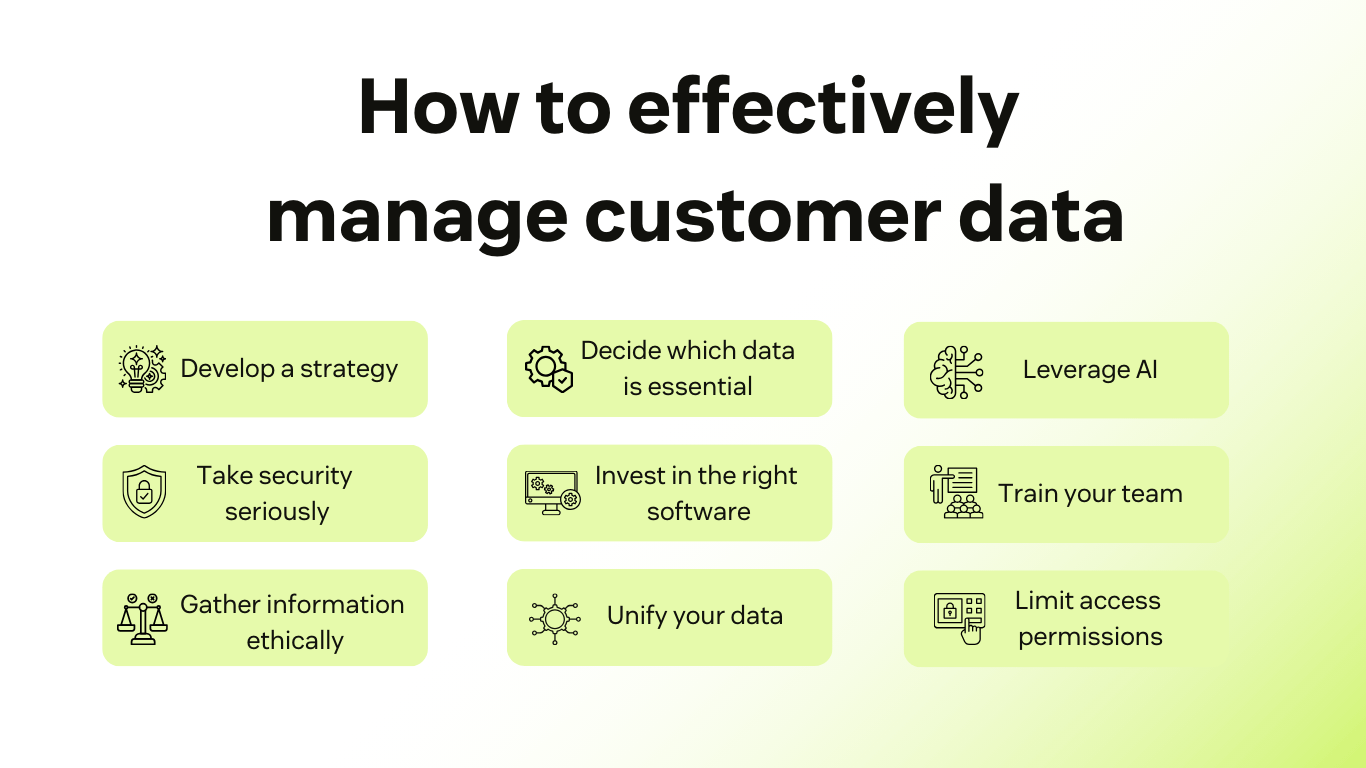
Although customer analytics can provide a lot of value to companies, the process of collecting it must be done properly. Here are nine customer data management best practices to ensure data quality, security, and usability.
1. Develop a strategy
The first step to manage customer data effectively is to develop a solid customer data management strategy. Defining a clear strategy ensures consistency and alignment with your company’s goals.
The three main steps to developing an effective strategy are:
- Align with business goals: Your strategy should reflect your organizational goals, such as improving retention or boosting sales. Prioritize data collection and usage based on how they contribute to the outcomes you want to achieve.
- Decide which data you need: It might be tempting to try and use as much data as possible, but you should prioritize accurate, relevant, and timely data. Focus on collecting only essential data for your specific use cases, as quality is better than quantity.
- Set a data governance strategy: Define data quality standards, establish access controls, and ensure compliance with privacy regulations like GDPR or CCPA.
A well-structured CDM strategy creates consistency across all departments, enforces accountability, and builds trust through reliable, high-quality data. Plus, setting a CDM strategy is key to ensuring uniform data collection across all channels and creating a necessary quality assurance process.
2. Take security seriously
In our CX Trends Report, a majority of leaders (56 percent) admitted to experiencing a data breach or cyberattack targeting customer data in the past year. The cost of a security lapse goes beyond financial penalties and lawsuits—a tarnished reputation could drive customers away for good.
Here’s how to keep your data safe:
Implement strong data encryption protocols.
- Use multi-factor authentication to access customer service analytics.
Regularly update and patch all software and systems.
Use firewalls and anti-malware tools.
Perform regular security audits and penetration testing.
Develop and maintain an incident response plan.
Investing in customer data protection is an investment in your company’s future, which is money well spent.
3. Gather information ethically
Being upfront about what data you’re gathering and how you plan to use it isn’t just good practice—it’s a requirement under laws like GDPR and CCPA. Plus, customers appreciate transparency. In fact, 75 percent of organizations believe that a lack of customer data transparency could lead to increased churn, according to our CX Trends Report.
Ethical data management also means practicing data minimization: only keeping the information you truly need and securing or deleting the rest. Zendesk provides several tools to help with this process, such as native credit card redaction and data deletion, automatic redaction, and multi-policy deletion schedules in ADPP.
Here are a few ways to ethically gain consumer insights:
Use clear language about what data you’re collecting and why.
Allow customers to opt out of data collection that makes them uncomfortable.
Make it easy for customers to manage their data preferences.
Provide an easy-to-understand privacy policy that outlines your data practices.
Also, regularly review and update your data collection practices to ensure they remain ethical and compliant with evolving regulations.
4. Decide which data you really need
Too much data—known as data saturation—can overwhelm your company with information and hinder decision-making. Hackers can also gain access to data you shouldn’t necessarily have. On top of that, outdated or irrelevant data leads to inaccuracies and poor decisions.
Instead, focus on collecting data that improves customer service and directly supports your business objectives. Ask yourself:
- Is this data critical for decision-making or improving CX?
Who will use this data, and how will it be applied?
Does this data have a defined purpose and value?
Is this data up to date, or are you holding onto it “just in case”?
The key is to be selective. Ditch anything that doesn’t have a clear use case or benefit, and make sure every data point aligns with what you’re trying to achieve. This way, your data works for you—not the other way around.
5. Invest in the right software
Choosing the right customer data platform (CDP) is important for creating an analytics environment that builds trust in data quality and streamlines workflows. The right solution can help you integrate data from various sources, ensure data accuracy, and provide actionable insights.
To create unified and reliable insights from information across departments and systems, combine your CPD with a strong master data management (MDM) system. This combination helps maintain a single source of information for all customer data, which ensures consistency and accuracy across departments and systems.
The ideal CDP should integrate with your existing tech stack, provide easy-to-use analytics and customer data visualization tools, and scale with your business growth. It should also offer robust data security features, like:
Detailed data access logs
Advanced data retention policies
Personal data redaction
Role-based data masking
Advanced encryption
Align your software choice with your business needs and ensure both your CDP and MDM platforms support compliance with data protection regulations. Investing in the right tools can significantly improve your data management capabilities and drive better business outcomes.
6. Unify your data
Customer data is scattered throughout email platforms, CRMs, social media channels, and other platforms. This fragmentation makes it challenging for businesses to build complete customer profiles. Unifying your data ensures everyone in your organization sees the same information.
To effectively unify your data:
Implement a central CDP that can aggregate data from multiple sources.
Create unique customer identifiers to link data across different systems and touchpoints.
Establish data governance policies to ensure consistency in how data is collected, stored, and used across the organization.
- Create accurate customer segments to group customers based on shared characteristics.
Regularly audit and clean your data to eliminate duplicates and resolve inconsistencies.
Creating a 360 customer view enables consistent messaging across all channels, personalized experiences, more accurate customer segmentation analysis, and more efficient customer service. By combining unified customer data with omnichannel analytics, businesses can gain deeper insights into customer interactions across every touchpoint and make more informed, data-driven decisions.
7. Leverage AI
By incorporating artificial intelligence (AI) into your CDM strategy, you can automate complex processes, uncover hidden patterns, and make better decisions based on actionable insights.
Here’s how you can leverage AI data analysis to optimize your data management efforts:
- Sift through mountains of sales data to identify trends, anomalies, and high-value opportunities.
- Continuously learn from new data to refine customer segmentation and improve targeting.
Use algorithms to identify and fix errors in your data, such as duplicate entries or inconsistencies.
- Analyze feedback to understand common pain points and gauge customer sentiment.
Integrate data from various touchpoints to deliver highly personalized experiences in real time.
- Track consumer behavior and anticipate future trends based on historical data.
AI tools can transform raw data into actionable insights, leading to more informed decisions, better customer experiences, and an enhanced customer data management strategy.
8. Train your team
Data management is only as strong as the people handling it. The reality is that most teams aren’t fully equipped to deal with data privacy and security complexities.
In fact, our CX Trends Report found that only 28 percent of leaders say their teams have advanced knowledge of data privacy best practices. That’s not a good look when you’re trying to show customers they can trust you with their information.
Here are some ideas to get everyone on the same page:
Don’t make data training a one-off event. Incorporate it into your onboarding and keep it fresh with regular updates.
Gamify the learning process to make it fun and engaging. Use quizzes, simulations, or role-playing exercises to reinforce what they’ve learned.
Complex data privacy laws can be hard to remember. Provide your team with easy-to-access resources that outline key points.
- Use case studies of real-world data breaches or security missteps to show the consequences of not following cybersecurity best practices.
Empowering your team with the necessary knowledge and skills mitigates risks while creating a company-wide culture that values protecting customer privacy.
9. Think about access
Who really needs to access your customer data? Limiting access to only those who need it can prevent accidental (or intentional) data mishandling. Implementing a “need-to-know” basis for data access can help:
Reduce the risk of data breaches.
Ensure compliance with data protection regulations.
Maintain customer trust by limiting the exposure of sensitive information.
Consider implementing role-based access control (RBAC) systems with granular permissions that grant access based on an employee’s job responsibilities. It’s also important to strengthen security further with IP restrictions, two-factor authentication (2FA), and single sign-on (SSO) to control and verify user access.
In addition, apply data masking to protect sensitive customer information from unauthorized visibility. Finally, regularly review and update these access permissions to ensure they remain appropriate as roles and responsibilities evolve.
Frequently asked questions
Customer story

“HR-related tickets contain sensitive data, and role-based access control ensures that information stays confidential”.
—Ashley Sprauge, Senior Director, IT & Corporate Engineering at GitHub
Streamline customer data management with Zendesk
Managing customer data is no small feat, especially when trust, security, and CX are on the line. But with the right strategy and tools, you can turn data into a competitive advantage, delivering consistent, secure, and personalized customer interactions at every touchpoint.
Learn how Zendesk safeguards your information and see how our advanced data privacy and protection tools take your security and compliance to the next level.